Posts

Lawyers as Catalysts for Change — Influencing Local Issues with Legal Insight

Image
Lawyers as Catalysts for Change — Influencing Local Issues with Legal Insight By: The Spiritual Lawyer 🦅 | RG Legal Support Services +919823044282 Introduction In a democracy like India, the local landscape—whether urban or rural—is often where the real challenges unfold: water scarcity, land disputes, illegal encroachments, poor governance, inadequate public services, environmental violations, or community rights being ignored. While these issues impact every citizen, lawyers are uniquely positioned to address them—not just in courtrooms, but in the heart of society. Local issues need legal eyes. And lawyers need to look beyond litigation. Why Local Issues Matter Most policy failures or systemic neglect starts at the grassroots. When roads remain broken, when ration shops deny food grains, when illegal liquor shops function near schools, or when a government hospital has no staff—these aren’t abstract governance failures. They are legal violations with direct consequences. Yet many o...

Top Policy Topics in India Needing Legal Work (August and September 2025)

Image
Top Policy Topics in India Needing Legal Work (August and September 2025) 1. Deepfake Regulation and AI Governance a. Deepfake crimes, AI-generated scams, misinformation via AI are exploding. b. India has no comprehensive AI regulation yet — only draft advisory papers. c. Lawyers are needed to draft frameworks balancing innovation and safety. Opportunity: Draft model laws, write legal analysis pieces, file PILs on misuse. 2. Climate Change and Disaster Management Laws a. After extreme weather events (especially in Northeast and coastal states), state preparedness is weak. b. The National Disaster Management Act (2005) is outdated for climate realities. Opportunity: Push for updated climate resilience and disaster management policies. 3. Digital Personal Data Protection Act 2023 — Compliance & Challenges a. The new Data Protection Act is active, but rules are pending. b. Mass confusion among companies, government departments, and small businesses. Opportunity: File for clarification...

Who Can Join as an Expert?

Image
Part A: Who Can Join as an Expert? Do you believe you are an expert in one or more of the following legal or allied fields? 1. Civil Procedure, 2. Partition, 3. Recovery, 4. Partnership, 5. Negotiation, 6. Contempt, 7. Criminal Law, 8. Bail Matters, 9. Forensics, 10. Chemical Analysis, 11. Information Technology, 12. Software, 13. Hardware, 14. Education, 15. Medical Science, 16. Accidents, 17. Accident Compensation, 18. Consumer Law, 19. Labour Law, 20. Industrial Law, 21. Departmental Inquiries, 22. Administrative Law, 23. Trust Law, 24. Revenue Law, 25. Armed Forces (Army, Navy, Air Force), 26. Railway Matters, 27. Taxation, 28. Finance, 29. Company Law, 30. Corporate Law, 31. Constitutional Law, 32. Tort Law, 33. Human Rights, 34. Civil Rights, 35. Intellectual Property Rights, 36. Media and Press Laws, 37. Entertainment Law, 38. Election Law, 39. Municipal Corporations, 40. Local Bodies, 41. Class Actions, 42. Family Law, 43. Divorce, 44. Maintenance, 45. Guardianship, 46. Contrac...

Intellectual Property Rights and Artificial Intelligence: An Overview of the Seven Core Rights

Image
Intellectual Property Rights and Artificial Intelligence: An Overview of the Seven Core Rights A. Introduction  Intellectual Property Rights (IPR) are the cornerstone of legal systems worldwide for protecting the creations of the human intellect. These rights provide creators and inventors with exclusive control over the use, dissemination, and commercialization of their work. With the rise of Artificial Intelligence (AI), the landscape of intellectual property is undergoing a transformative shift, challenging traditional notions of authorship and ownership. This essay explores the seven key types of IPR, their relevance in the modern world, especially in the context of AI, and discusses notable global and Indian judicial pronouncements that have shaped the understanding of these rights. 1. Copyright a. Definition: Copyright protects original literary, artistic, musical, and dramatic works, including computer programs and digital content. b. AI Relevance: Questions arise over who o...

How to Obtain Copyright

Image
How to Obtain Copyright A. Introduction  In the modern era, where creative content plays a central role in business, education, entertainment, and communication, protecting original work is vital. Copyright offers legal protection to creators, ensuring that their work is not used without permission and that they enjoy exclusive rights over their creations. This essay explores the concept of copyright and outlines the process of obtaining it, with a focus on the Indian legal system. B. What is Copyright? Copyright is a legal right granted to the creator of an original work, such as literary, artistic, musical, or dramatic content. It includes rights like reproduction, distribution, performance, translation, adaptation, and public display. Copyright protects expression of ideas, not the ideas themselves. In India, copyright is governed by the Copyright Act, 1957, and administered by the Copyright Office under the Ministry of Commerce and Industry. C. Types of Works Protected The foll...

How to Obtain a Geographical Indication (GI): A Step-by-Step Guide

Image
How to Obtain a Geographical Indication (GI): A Step-by-Step Guide A. Introduction  In a global marketplace driven by authenticity and tradition, Geographical Indications (GIs) serve as a powerful tool to protect the unique identity of regional products. Whether it's Darjeeling Tea, Banarasi Sarees, or Mysore Sandalwood, a GI not only acknowledges the origin of a product but also helps preserve cultural heritage and promote economic development for local communities. This article outlines the procedure for obtaining a Geographical Indication in India, as governed by the Geographical Indications of Goods (Registration and Protection) Act, 1999. B. What is a Geographical Indication (GI)? A Geographical Indication is a sign used on products that have a specific geographical origin and possess qualities, reputation, or characteristics essentially attributable to that location. It is typically used for agricultural products, handicrafts, industrial goods, or food items that are intrinsi...

How to Obtain a Patent: A Step-by-Step Guide for Inventors and InnovatorsA. Introduction

Image
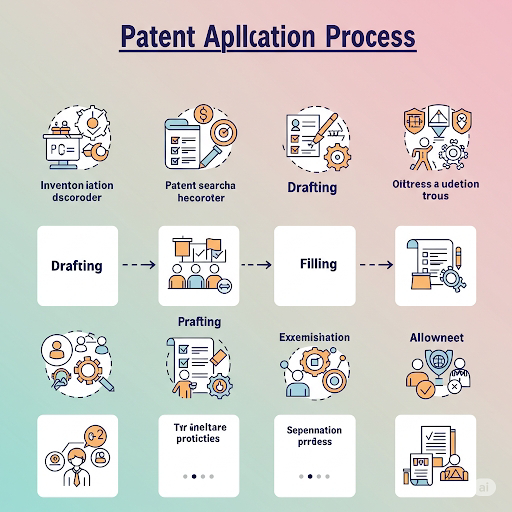
How to Obtain a Patent: A Step-by-Step Guide for Inventors and Innovators A. Introduction  Innovation is the driving force of progress in today’s economy, and protecting your innovative ideas is just as important as developing them. A patent provides inventors with an exclusive legal right to use, make, sell, or license their inventions for a specific period. It acts as a shield against unauthorized use by others and adds value to businesses, startups, and research-based enterprises. This article provides a step-by-step guide to understanding the patent registration process, with particular reference to Indian law (governed by the Patents Act, 1970), though the overall process is similar in many jurisdictions. B. What is a Patent? A patent is an exclusive right granted to an inventor for a novel invention that is capable of industrial application. It may be a product, process, machine, software, or technical improvement, provided it meets the statutory criteria. C. Eligibility Crit...